
Artificial Intelligence

Scalable AI Solutions for Education

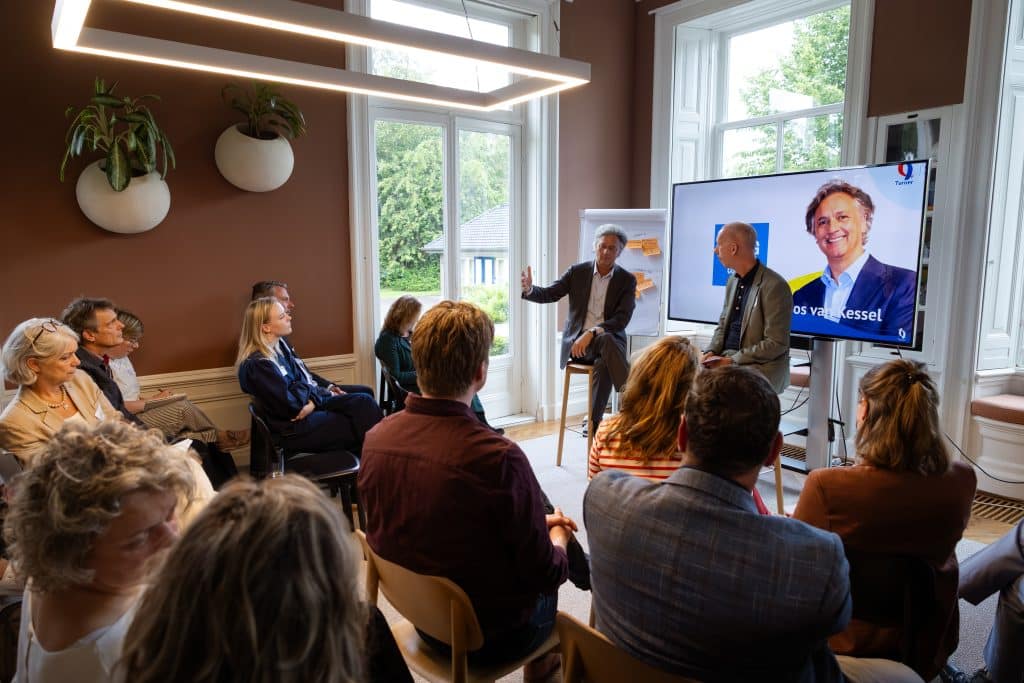
Jeroen Visscher of Turner has joined the Dutch AI Coalition as the leader of the Education working group. Recently, he has brought together a team of stakeholders from education, research, the business community, and government to join this working group. It’s time to meet one of the working group’s founding members: Gerdinand Bosch, the CIO of Avans University of Applied Sciences.

Interview with Gerdinand Bosch

Gerdinand Bosch is one of the first core team members of the Education Working Group within the Dutch AI Coalition. As CIO of Avans University of Applied Sciences, he immediately recognized the value and necessity of a broad coalition for AI. What brought him to the NL AIC? What does he expect from AI in education? And from the Education Working Group itself?

What is your background?

“As CIO, the digital transformation of Avans University of Applied Sciences is one of my top priorities. Education institutions have traditionally not been very involved with IT in relation to learning, but new technologies are truly at the heart of education. This is now in the spotlight because of the coronavirus, but it’s a development that’s been underway for some time. The way we work within educational institutions is going to change significantly. We need to start thinking and working more like a software company.”

And what role does AI play in that?

“I think the physical and digital worlds will soon become equally important in Education. AI plays a very important role in this, because it allows you to, as it were, overlay the two worlds. You can already see this happening every day. The route you take is influenced by your navigation system, which in turn is fed by the behavior of other road users. Even your trip to the grocery store is a constant interplay between the physical and the digital: with personalized offers, self-checkout—you name it. You want to create that same ‘digital dexterity’ in Education: so that digital education also feels very personal and engaging.”

How did you end up joining the Dutch AI Coalition?

“AI in education won’t take off on its own. At Avans University of Applied Sciences, we also see the opportunities and are conducting our first experiments. Still, it’s difficult to move beyond that initial phase. To make significant progress with AI on a larger scale, you need to collaborate: with other educational institutions, with researchers, with vendors, and with the government. Through our Executive Board Chair, Paul Rüpp, I came into contact with Jeroen Visscher (leader of the Education working group, ed.) last fall. The AI Coalition seems to be exactly that kind of ecosystem. And I immediately said “yes” when I was asked this fall to help build the Education Working Group.”

"AI in Education won't take off on its own. To make real progress with AI on a larger scale, you have to work together."

Gerdinand Bosch, CIO of Avans University of Applied Sciences

What's the latest on the Education Working Group?

“There’s a lot of energy, but it’s still in its early stages. We’re still getting to know each other. After all, we started out as a core team of six people, and by the end of the year we’d brought even more people into the working group. In early 2021, we really got started with about 60 people from education, research, the business community, and government. We quickly concluded that we wanted to start by getting a clear overview. There’s really a lot going on: in elementary schools, in secondary schools, and among software providers. But how do you connect all those initiatives and experiments with one another?”

Why is it so important to connect those initiatives?

“As I said, it’s very difficult to move beyond the experimental phase. Different stakeholders need different things to truly make progress. Companies are looking for ways to make money with AI. Educational institutions want to know how they can use AI in a meaningful and ethically responsible way for students, faculty, and the professional field. Researchers, on the other hand, need funding to conduct research. Governments need more insight before concrete policies can be formulated. These elements don’t come together on their own; you have to work together to make it happen.”

What do you expect from the NL AI Coalition in this regard?

“This is where all stakeholders come together around the table—the ‘quadruple helix.’ This is the place to tackle plans holistically right from the start, so that you can collectively limit or share the risks. Because that is the biggest obstacle to scaling up AI: there are still too many uncertainties, which make investments uncertain. In the NL AI Coalition, you can gain collective experience regarding appropriate laws and regulations: which existing laws are hindering progress, and which are accelerating it? Or regarding standards for IT and data. For example, who owns what information: the student, the educational institution, or the software vendor? You want to know that before you invest further in a prototype.”

Is there also a social interest at stake?

“Absolutely! I think that from the Netherlands—or rather, from Europe—we now need to think about and invest in the kind of AI that suits us. AI that aligns with our norms and values. In China, AI seems to primarily serve the interests of the government. In the United States, AI seems to primarily benefit the business community. I think Europe can offer a third way: AI in the service of society as a whole. The NL AI Coalition’s motto captures this as well: ‘algorithms that work for everyone.’ But we’ll have to move quickly, because China and the U.S. are advancing at a rapid pace right now.”

Want to learn more about our participation in the Dutch AI Coalition?

How does that translate to Education: what should AI offer the field of Education?

“In our working group, too, we want AI to serve society. The higher a society’s level of education, the higher its Gross National Product—and its gross national happiness. Within our working group, we’ve said: AI in Education must serve students and teachers. We want AI to help students with learning, for example through adaptive learning. And we want teachers to feel supported by AI, for example by saving them time and helping them reflect on how they can best facilitate student learning. We’ve also included this in our manifesto.”

What exactly are you working toward within the working group?

“So the ultimate goal is to make those scalable AI solutions possible in Education. With initiatives like this, it can sometimes be difficult: how do you ensure it doesn’t just remain talk? That’s precisely why we’ve started ‘taking action.’ We’re shaping our implementation plan based on the pilot projects we’re carrying out this year. Transparency and trust are key to this. We need to recognize that everyone involved has their own interests while keeping our eyes on that shared ultimate goal.”

And back to your own interests: what is your role and that of Avans University of Applied Sciences?

“We’ve already had some great experiences with AI ourselves; for example, we had students create their first chatbot to handle support questions. We also have several faculty members who are active in the fields of robotics, data science, and Elsa Labs. “We contribute our knowledge and experience, just like the other participants. Together, we gain a comprehensive overview and can tackle plans in a holistic manner.”

"Gerdinand has a natural ability to bridge the gap between Education, research, the business community, and the government."

Jeroen Visscher, managing partner at Turner

Jeroen Visscher, leader of the Education Working Group, on Gerdinand’s participation: “I am very pleased that Gerdinand has joined our core team. He has a keen understanding of what is required for a complex transformation and is a natural connector. This enables him to naturally bridge the gap between Education, research, the business community, and the government.”

Regarding developments within the Education Working Group itself: “The NL AI Coalition was founded to bring together all knowledge, ideas, and initiatives related to AI. The fact that, so soon after its launch, we have all parties from the ‘quadruple helix’ at the table shows that we are on the right track. There is a great need for this, as evidenced by the more than 60 working group members who have joined. So far, we’ve mainly focused on gathering all the insights from the members themselves. In March, we’ll take the next step: we’ll launch a series of roundtable discussions where students and faculty will engage with the working group to discuss AI. This will help us stay curious and gain an even better understanding of how AI can serve students and faculty. After all, that is the ultimate goal we want to keep in mind.”

Want to learn more about AI and the Dutch AI Coalition?

All news articles by Turner

Healthcare
Alexander Bruinsma

Klimmendaal

At the initiative of Verstegen Accountants in Dordrecht, Edwin Schippers of Turner conducted an organizational assessment of Klimmendaal, a rehabilitation center headquartered in Arnhem. The organization was facing several challenges:
Read morer »
Turner Healthcare Services
Health innovation
Alexander Bruinsma

Healthcare Innovation Monitor

Healthcare Innovation The Healthcare Innovation Monitor Learning Together from the COVID-19 Crisis What exactly is making major changes possible right now during the COVID-19 crisis?

Read morer »
Financial Services
Alexander Bruinsma

Aegon

Business Property Damage Transition Aegon Netherlands Clear Vision Driven by core values New criteria as the deciding factor From Vision to Execution Insurer Aegon has

Read morer »

Contact​

We would like to get to know you.
Do not hesitate to contact us if you have any questions!

Huize de Boom
Arnhemseweg 107
3832 GK Leusden

Phone: +31 (0)33 – 285 93 00
Email: info@turner.nl

Make an appointment

Would you like more information or a tailor-made quote? Fill in the form for a no-obligation appointment.