Healthcare Innovation
The region is a leader
Through the Healthcare Innovation Monitor and the seminar “Healthcare Innovation: Beyond the Crisis,” Turner is exploring how innovation in healthcare can be accelerated on a lasting basis. In the spring, the COVID-19 crisis gave innovation a huge boost. This fall, that momentum seems to have slowed. We see a key role for the region in regaining that momentum. How exactly?
Healthcare Innovation: The Region Leads the Way
Based on discussions with healthcare administrators, healthcare professionals, and other stakeholders in the Healthcare Innovation Monitor and during the seminar “Healthcare Innovation: Beyond the Crisis,” we see a key role for the region in accelerating healthcare innovation once again. This can be achieved in four steps.
Step 1: Launch regional partnerships
Collaboration in the region is the key to successful innovation. Integrated care and comprehensive care pathways require regional coordination. Innovation calls for collaboration that goes beyond self-interest. Who will take the lead in overcoming institutional barriers?
Through the JZOJP initiative, healthcare providers are focusing on shifting care, preventing the need for (more expensive) care, and replacing care (with eHealth, for example) in order to make the Dutch healthcare system future-proof.
This raises a number of new questions: Who is in charge in the region? How do we collaborate in the region? What alternative funding models are appropriate in this context? How do we ensure that innovation and cost savings go hand in hand? How do we effectively “reorganize” healthcare in the region? At the seminar on September 10, various opinions were expressed on these topics:“Healthcare needs more leadership right now,”“The pandemic acted as a release from the rigidity in our system—the focus shifted back to care rather than money,” and“Forming the right partnerships is an art.”
New partnerships can only be formed if the patient is at the center, healthcare is the guiding principle, and the parties subordinate their own interests to the common good. Of course, there are a number of fundamental and practical objections standing in the way. The only way forward is to overcome them. See points 2, 3, and 4 for more on this.

“The new ‘holy grail’ lies in the region, with the Right Healthcare in the Right Place. Only by working together can you build the trust needed to collaborate. It’s just a matter of getting started.”
– Frank de Reij, Chairman of the Board of Meander MC
Step 2: Work on (medical) leadership and stamina
With (medical) leadership and perseverance, we can tackle cultural challenges. Innovation is more of a cultural and organizational challenge than a technological one. (Medical) leadership is crucial during large-scale changes. Key factors that play an important role here include:
- the ability to articulate a vision for healthcare in clear terms and with a “no turning back” approach.
- a smart change strategy and making the challenge manageable. Factors such as courage, sincerity, authenticity, persuasiveness, likability, rewarding the “believers,” and the leadership team’s steadfastness also play an important role in the change strategy, approach, and style.
- patience in influencing stakeholders (patience in repeatedly explaining the intent and the consequences).
- acknowledging the pain involved in letting go of old patterns (loss of status, security, and routine that may accompany a change in role).
- the recognition that change requires a great deal of effort and, therefore, a great deal of capacity and time
To ensure that healthcare innovations survive the crisis, it is important to prioritize and involve (end) users in all phases of development; only then will they have a chance to deliver value on a large scale and in the long term.

“Process innovation often falls short because it requires healthcare professionals to change the way they work”
– Dianne Jaspers, Family Physician, HAP Eemland
Step 3: Take advantage of legal options
It is a huge challenge to translate Digital Innovations in Healthcare into practical applications quickly, effectively, and within the legal framework. With early legal support, issues such as data exchange can be properly organized.
A key issue is the exchange of health data between healthcare institutions, local governments, and healthcare regulators. In the absence of a national electronic health record (EHR) system, patients are, in practice, given their health data on a CD when they are transferred to another healthcare institution. Why was this able to happen quickly, effectively, and within the legal framework during the COVID-19 pandemic? Bold, creative concepts like the “Personal Health Train,” developed by the Dutch Healthcare Institute, seem to shed new light on the matter. It gives us food for thought: sharing information in the patient’s best interest should be easier.
It seems as though the patient is already much further along in his thinking about privacy. The patient of the future manages his or her own health data and decides who has access to it and for what purpose it may be viewed. As one participant at the seminar put it, “I’m happy to share my data if I know it will help us all become healthier.”

“Apply the analysis to the data rather than the other way around—that’s essentially what it’s all about.”
– Wouter Franke, advisor at the Dutch Healthcare Institute
Step 4: Make innovation and cost savings go hand in hand—it’s possible
Creative boldness gives rise to financial models in which cost savings and innovation go hand in hand. Funding innovation in healthcare is often impossible due to the “silos” within the healthcare system. Moving innovation “beyond the crisis” requires alternative funding models. Promoting prevention, self-care, and digital primary care—it can and must be done!
From healthcare to wellness; insurers are increasingly focusing on “reverse health insurance” plans that reward healthy behavior. This shift is positive but is progressing very slowly, partly due to regulations and the Ministry of Health, Welfare, and Sport (VWS). In addition, hospitals are currently prohibited from making a profit. Cost-cutting is their responsibility, but that is different from having the financial flexibility to invest in Innovation.
What is the government’s role in this? Larger innovation funds aimed at improving public health would help. The key question is how we can limit conflicting financial interests in the future. In other words, we must ensure that the playing field and the rules are adjusted so that all the major players are on the same team with the same goal, where cost savings and innovation reinforce each other rather than being at odds with one another.
Meet the Author
All Insights on Healthcare Innovation

Healthcare Innovation Monitor
Healthcare Innovation The Healthcare Innovation Monitor Learning Together from the COVID-19 Crisis What exactly is making major changes possible right now during the COVID-19 crisis?

Skipr | Development of data-driven Healthcare scores well below the passing grade
Healthcare Innovation Skipr | Development of data-driven Healthcare receives a failing grade Skipr, the publication for healthcare professionals, is highlighting the results of the first

Consultancy.nl | The Impact of COVID-19 on Innovation in the Healthcare Sector
Healthcare Innovation Consultancy.nl | The Impact of COVID-19 on Innovation in the Healthcare Sector Consultancy.nl reports on the results of the first round of Turner’s

Innovating with Data in Healthcare?
Artificial Intelligence Innovating with data in Healthcare? Oil the machine first. Turner’s healthcare expert Egbert Clevers is already seeing wonderful examples of data-driven innovation in

Healthcare Innovation: The Region Leads the Way
Healthcare Innovation The region is a leader Through the Healthcare Innovation Monitor and the seminar “Healthcare Innovation: Beyond the Crisis,” Turner is exploring how innovation

Fraud Risk from a Different Perspective
Fraud risk from a different perspective: “By providing frameworks, you create freedom.” Fraud risk management isn’t limited to simply tightening procedures. In fact, corporate culture and behavior have a major
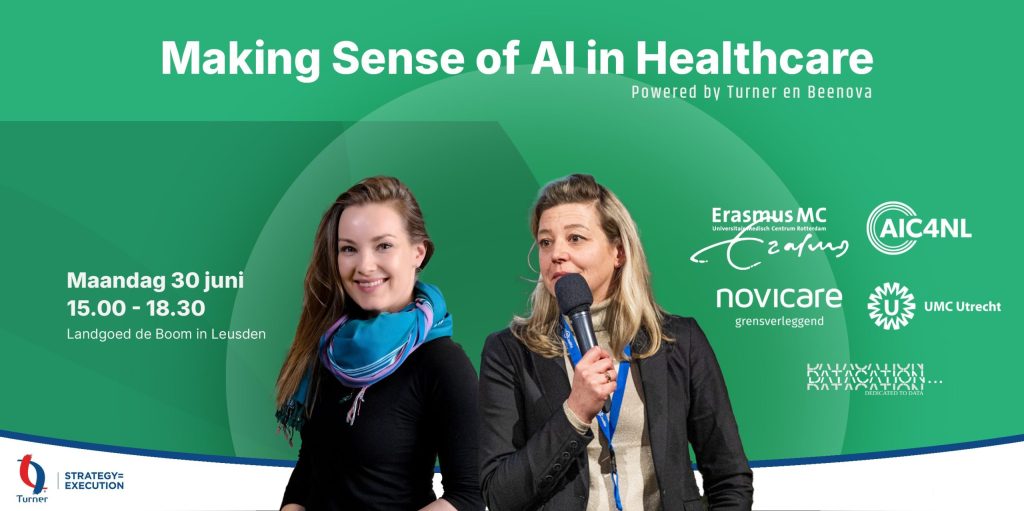
Master Class: Making Sense of AI in Healthcare
Artificial intelligence is evolving at a rapid pace, offering many opportunities in the healthcare sector and promising even more for the future. But it also presents dilemmas for organizations and

AI in Healthcare: From Strategy to Pilots to Implementation
The healthcare sector faces major challenges: an aging population, rising costs, and the threat of declining quality. AI offers opportunities for fundamental renewal, but only a fraction of the hundreds
Contact
We would like to get to know you.
Do not hesitate to contact us if you have any questions!
Huize de Boom
Arnhemseweg 107
3832 GK Leusden
Phone: +31 (0)33 – 285 93 00
Email: info@turner.nl
Make an appointment
Would you like more information or a tailor-made quote? Fill in the form for a no-obligation appointment.
