Portfolio Management in Education: Striking a Balance in a Complex Process

The education sector faces major challenges. Social and economic transitions, declining student enrollment, and budget cuts are forcing principals and administrators to reflect on the future of their institutions. With its Masterclass in Integrated Portfolio Management, Turner offers a platform for dialogue and connection, as well as a shared starting point for Strategy Execution of educational portfolio management.

Turner provides its clients with timely, fresh, and relevant insights into their markets and the Strategy Execution challenges they face. This blog is a report on the Education Portfolio Management masterclass organized by Luuk Binder, Jasper Engelbert, Caecilia Moerdijk, and Annelieke van Schie —experts in Strategy Execution in the Education sector at Turner.

Working Together on Portfolio Management in Education:

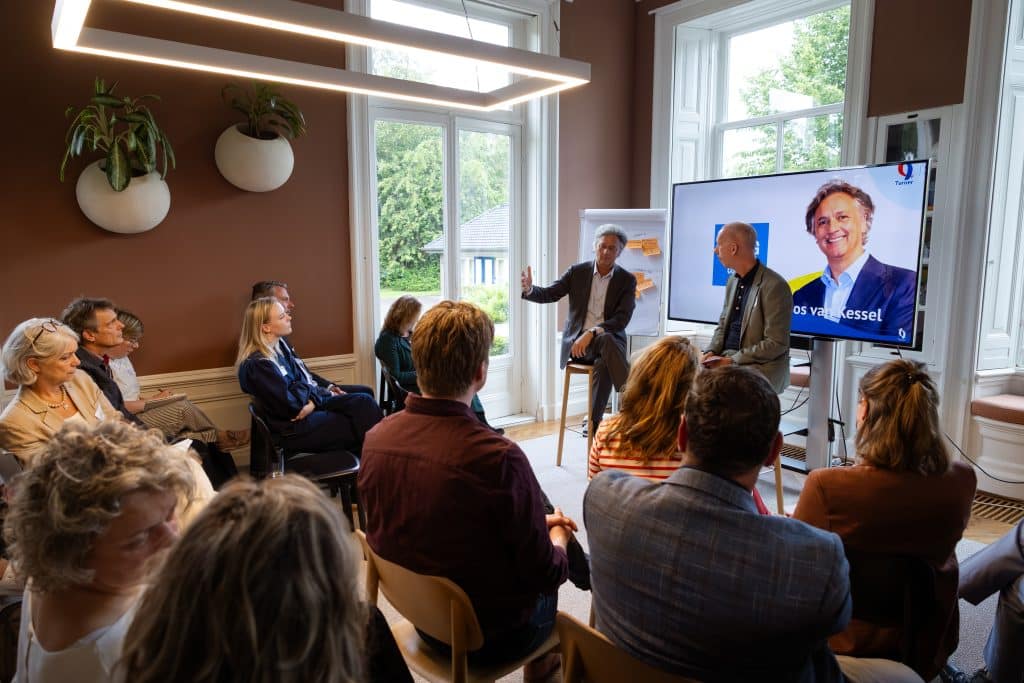
Turner’s home, the De Boom residence, is nestled in the countryside. On April 8, 2025, participants in the Education Portfolio Management masterclass gathered there. With the garden doors open and seated at picnic tables outside, administrators, managers, and consultants from vocational, higher vocational, and university education got to work. Inspired by both the timely topic and the opportunity to connect with one another, it turned into an intensive and valuable afternoon. Strategy Execution at its best.

Plenty of challenges

How do you determine which programs you want to engage in Continuous Development for and which are less future-proof? That was the focus of the masterclass on Portfolio Management in Education, which Turner organized for the second consecutive time. Caecilia Moerdijk, a Strategy Execution consultant at Turner, first asks the participants to identify the challenges they face. There are quite a few. Establishing a distinct identity, profitability, long-term versus short-term priorities, focusing on the job market or on students’ preferences, ensuring Innovation—these are just a few of the many perspectives. It quickly becomes clear that everyone recognizes the issues others are facing. Whether you’re a vocational, community college, or university institution, you all face the same issues.

The same applies when it comes to challenges in the portfolio management process. There are plenty of them. For example, the question of whether to organize portfolio management centrally or decentralized. How to get your organization on board with unpopular decisions. How to deal with unhealthy internal competition, both within your institution and in your region. How to develop a sound analytical model using objective data on which to base your decisions.

A simulation game as an exercise

To truly experience what it’s like to make portfolio decisions, a simulation game is used. Participants work through a simulation developed by Turner, in which De Boom University of Applied Sciences must make changes to its educational portfolio due to declining student enrollment and budget cuts. The participants play their roles with enthusiasm, and it quickly becomes clear just how complex such a decision-making process is. While one participant wants to focus primarily on the institution’s own strengths, another favors greater coordination with the region. Participants do not want to let “their people” down and defend the continuation of a program that, objectively speaking, has little justification for existing. Emotional arguments and factual arguments are intertwined. A striking number of programs were eliminated from the portfolio of a director who was unable to attend this simulation meeting.

The simulation game made it clear: this is not the way to do it. Start with insight—insight into where you want to go and where you are now. Establish an evaluation framework and answer the question: based on what criteria will we retain or eliminate programs? Transparent, clear, and guiding statements are indispensable in this process. Objective data can prevent a lot of debate, even though emotions will always play a role.

Find the Balance: Barry Johnson’s Polarity Management Model

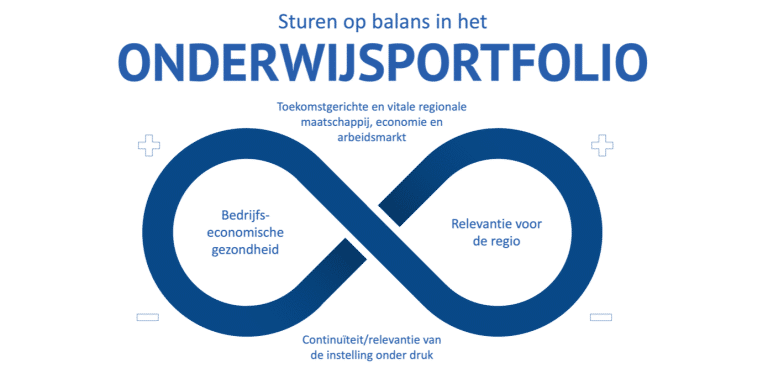
After the game, Jasper Engelbert of Turner takes the floor. He presents the model that Turner successfully uses in its portfolio management process: Barry Johnson’s Polarity Management Model (see Figure 1).

Figure 1. An example of promoting balance in the educational portfolio

The foundation of the model is the idea that choices—including those made in the context of portfolio management—must serve a higher purpose. So start by defining that objective. Next, says Barry Johnson, on the path to that objective there are always apparent contradictions that seem to force a choice and feel like a dilemma (the polarities). As you navigate between the poles, don’t seek out the extremes, but make sure you steer toward balance. Be aware of the positive and negative effects of both poles.

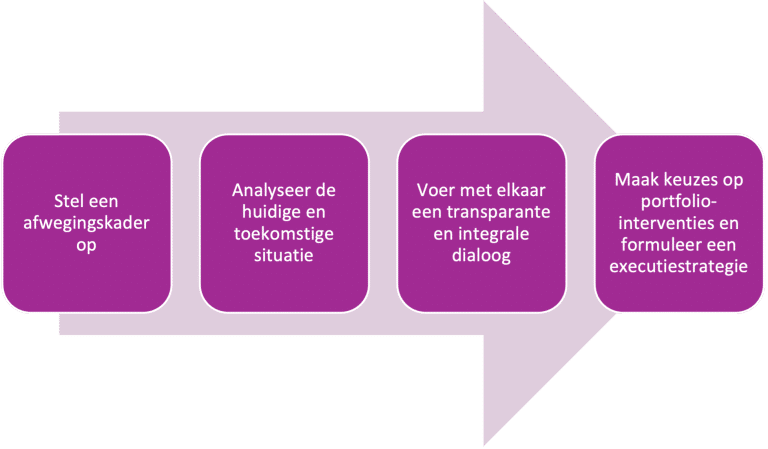
But how do you do that? Jasper: “In short, it comes down to the following four steps:

Figure 2: A simplified version of the portfolio management process: from strategic frameworks to concrete decisions

Base your evaluation framework on your mission, vision, and strategic pillars. Formulate the requirements that education, research, operations, and commercialization—the resources you use to work toward your mission—must meet. For example, “I want engaging education, high-impact commercialization, and sound operations.” Then make those requirements concrete and measurable.

The evaluation framework serves as the basis for data collection and analysis. It reveals which programs “score” well and which do not. To then make informed decisions, a transparent and comprehensive dialogue is necessary. Jasper: “Not just based on gut feelings, but on data and insights supplemented by experiences and context. To avoid muddying the discussion, it helps to bring focus to the dialogue. For example: based on a comprehensive picture of the performance and relevance of all degree programs, which ones should we really be discussing?”

Dry swimming

To build support for a new approach, it can help not to attach any consequences to your choices at first. This gives programs time to adapt to the new situation or to transform themselves into programs that do have a promising future. In other words, “dry runs.” A term that was mentioned frequently throughout the rest of the masterclass. It really helps!

Here’s another tip: form a coalition, and be sure to include benefit owners and implementers in it.

Thea Koster, Chair of the Executive Board at Deltion College, on practical experience

Deltion College in Zwolle began implementing portfolio management two years ago. Thea Koster, chair of Deltion’s Executive Board, talks about the ups and downs of the process. How do you move from a situation where everyone believes their own program should remain as is to a widely supported portfolio management system where real choices are made? Thea’s story is about streamlining sluggish processes, about data, emotions, a coalition, treading water, butchers judging their own meat, and the six-eyes principle.

Quick Check: Where Do I Stand?

To get off to a good start, Turner developed a quick scan. Where do we stand with portfolio management? What’s going well, and what’s not going so well? Filling out and discussing the scan led to a lively discussion. Insights were shared, and new perspectives emerged.

Five Insights

  1. Don’t jump right in at the deep end when it comes to cutting programs; practice in shallow water first.
  2. You can counter emotional arguments with objective data, but don’t use data to dismiss everything.
  3. Form a coalition: involve executives and directors, as well as those who will be responsible for implementing the decisions.
  4. Portfolio management is also organizational change.
  5. Effective portfolio management fosters insight, energy, and Ownership.

*****

“We’ve been through this process ourselves before. So we know that portfolio management is a great way to get a clear picture of where you stand. But it’s just as important to come together and meet people who are also interested in this topic. It’s really nice to hear how they think about their portfolios. I’m used to taking a broad view, so I’m always interested in how others deal with these issues, especially when people are as open as they are today.”
Patrick Bemelmans, director of the Academy for Communication and Creative Business at NHL Stenden

“This issue is relevant everywhere, for everyone. The Profolio tool can certainly help us make decisions, too.” “I was glad to have the chance to meet people here from across the country who are dealing with the same issues. I also find the presence of colleagues from vocational education valuable; it’s interesting to hear how they view certain things. Thinking things through together always makes it easier.”

Antoine Kunst, Director of Operations at HZ University of Applied Sciences

*****


Portfolio Management
Education institutions face major challenges: declining enrollment, budget cuts, and a changing job market. Professional portfolio management helps vocational schools, colleges, and universities ensure their educational portfolio remains relevant and organize a future-proof education system.

Optimize Your Educational Portfolio

Turner offers a variety of options to provide targeted support to institutions in professional portfolio management, tailored to their specific needs and challenges.

  • Profolio: An information product that provides a comprehensive overview of the performance and relevance of the educational portfolio. Based on >, it draws on 25 sources and benchmarks from comparable programs. This provides an objective starting point for a professional portfolio process.
  • Professionalizing Portfolio Management: Implementing a sustainable process for portfolio development based on collaborative design, demonstration, collaboration, and self-direction.
  • Strategic Portfolio Dialogue: Guiding decision-makers in setting priorities for the ongoing development of the education portfolio, all in one day.
  • Prioritization of Strategic Options: Analysis of Portfolio opportunities and challenges—such as market contraction and partnerships—based on quantitative and qualitative insights. Includes clear options for interventions.

On Wednesday, June 10, 2026, Turner once again organized the “Integrated Portfolio Management” masterclass. This event was designed specifically for board members, executives, and policy advisors at secondary vocational education (MBO) and higher professional education (HBO) institutions. Would you like to be notified about the next masterclass? Please fill out the form.

Want to learn more about Turner Education?

How can universities and vocational school foster learning and development, now and in the future?

Turner Education helps professionals take education to the next level.


Would you like to improve, innovate, and transform faster?

Turner is specialized in strategy execution. We make it our business to turn an organisations strategy into reality. For the seventh consecutive year, Turner has been recognized by clients as the best strategic consulting firm in the Netherlands. More than 4,000 executives and professionals participated in the MT1000 survey, in which Turner received the highest ratings for strategic consulting, client focus, excellent execution, and product leadership.

MT1000 EN Series

Read more about the results other clients achieved with the support of Turner Strategy = Execution. Ready to talk? Schedule an appointment. Contact us.

Make an appointment

Would you like more information or a tailor-made quote? Fill in the form for a no-obligation appointment.

All of our specialists' insights on Education

notebook hand
Digital & Commercial excellence
Alexander Bruinsma

NHL and Stenden

Collaboration Model and Transition Path for a Merger NHL and Stenden Shared Ambitions and Opportunities Coordination of the Entire Program Higher-quality education and research NHL

Read morer »

Explore more of our work

notebook hand
Digital & Commercial excellence
Alexander Bruinsma

NHL and Stenden

Collaboration Model and Transition Path for a Merger NHL and Stenden Shared Ambitions and Opportunities Coordination of the Entire Program Higher-quality education and research NHL

Read morer »
Education
Alexander Bruinsma

HAS University of Applied Sciences

Accelerated Implementation of the Educational Vision Flexible and Adaptive Education Made a Reality A Concrete Vision for Educational Reform Insights into the Progress of Educational Reform Self-Assessment for Faculty and

Read morer »
Education
Alexander Bruinsma

Noorderpoort

Digital Innovation in the Classroom ROC Noorderpoort Experimentation in Education Innovation in Attendance Tracking Saving Class Time Digital Innovation is high on the agendas of

Read morer »
Education
Alexander Bruinsma

The Hague University of Applied Sciences

Faster assistance for students Clear responsibilities for teaching and education support staff A practical improvement plan for a critical process: testing and examinations. Accelerating progress on challenging issues: fraud detection

Read morer »
Education
Alexander Bruinsma

Noorderpoort

A new direction for Noorderpoort that aligns with society in 2035. Strategy Execution: immediately testing the strategy in practice through experiments. Close alignment with the needs of students and the

Read morer »
Education
Alexander Bruinsma

Radboud Academy

The successful application for the LLO Catalyst from the National Growth Fund stems from the partnership between Radboud University, Maastricht University, and the Open University to collaborate on Lifelong Development.

Read morer »
Education
Alexander Bruinsma

Landstede MBO

“Lifelong Development is now firmly established.” Landstede(tag) has fully integrated Lifelong Development (LLO) into its vocational education (MBO) programs. With a clearer vision, collective ownership, and a strong Execution Coalition,

Read morer »
Education
Alexander Bruinsma

ROCvA-F

How do you drive progress in digitalisation within a decentralised education organisation? At ROCvA-F, a smart approach involving a ‘0.7 version’ led to greater clarity, support and acceleration.
Read morer »
Education
Alexander Bruinsma

INNOVO

The development of INNOVO’s new course plan in South and Central Limburg was an unconventional exercise. Due to previous circumstances, the 43 affiliated schools had only recently developed their own

Read morer »

Contact​

We would like to get to know you.
Do not hesitate to contact us if you have any questions!

Huize de Boom
Arnhemseweg 107
3832 GK Leusden

Phone: +31 (0)33 – 285 93 00
Email: info@turner.nl

Make an appointment

Would you like more information or a tailor-made quote? Fill in the form for a no-obligation appointment.