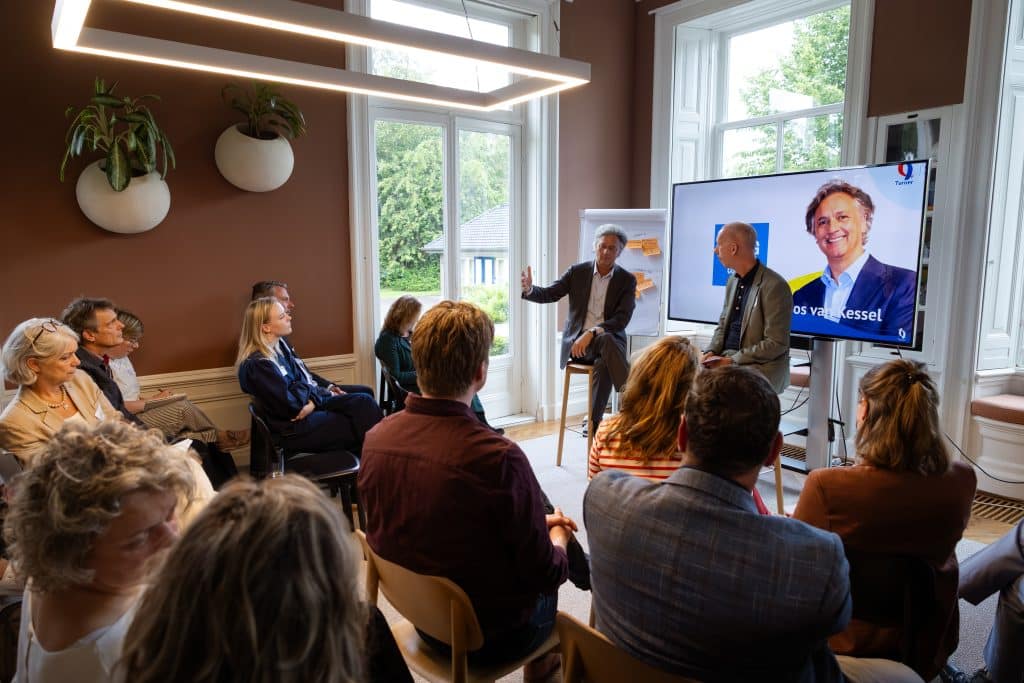
A Balanced Offering: A Nationwide Education Portfolio

The Minister of Education is calling for greater collaboration and coordination regarding educational offerings, particularly in light of the Balanced Internationalization Act, budget cuts, and declining student enrollment. This is an important moment for university administrators to reevaluate their decisions regarding their educational portfolio.

Turner provides its clients with timely, fresh, and relevant insights into their markets and the Strategy Execution challenges they face. This blog is part of a series on Portfolio Management by Jasper Engelbert, Tjalle Hoekstra, Nicolai Manie, and Caecilia Moerdijk, experts in Strategy Execution in the Education sector at Turner.

Working Together on Portfolio Management in Education:

The Minister of Education calleds educational institutions calls for greater cooperation and coordination regarding educational offerings in the Netherlands. This call is inextricably linked to the announcement of the Balanced Internationalization Act (WIB), the already announced budget cuts, and the current decline in the student enrollment. A significant moment for university administrators to consider the question: How do we, as an institution,board of directors choices About Our Education Portfolio?

Balanced internationalization leads to a balanced educational portfolio

The WIiB originated as a response to housing challenges in a number of college towns with limited housing options and to preserve the Dutch language in Education. In its current form, however, the law is not limited to those issues . The law also addresses the proliferation of degree programs, sparking a debate on how to prune them back. After all, it seems clear that such pruning is necessary. In addition to the WIiB, (1) the demographic trend leading to declining student enrollment, (2) budget cuts that further increase financial pressure, and (3) questions about the effectiveness of degree programs are placing a heavy burden on institutions—and the system as a whole.

This raises the question of whether the current national educational offerings can actually be maintained—in vocational education (MBO), higher professional education (HBO), and certainly in academic education as well. In the university sector, the question is how the educational portfolio can be realigned without undermining the value of Dutch higher education and research as a whole.

Strategic Portfolio Management: Leading with Both the Head and the Heart

At a university, it seems to be a given that the academic portfolio is constantly expanding. Programs are rarely discontinued, and new bachelor’s and master’s programs are added every year. Incidentally, this often follows the same pattern: a professor, department, or faculty identifies opportunities for an interesting program; the Executive Board is convinced; the University Council approves it (sometimes with some justified grumbling); and an application is submitted to the CDHO.

Part of that application is a labor market analysis to determine whether the new program actually meets market demand. In addition to this feasibility assessment, universities often conduct their own internal analysis to reduce the risk of cannibalization. As an institution, you naturally don’t want to launch a bachelor’s program that draws away half the incoming students from another bachelor’s program. That’s strategic portfolio management “light.” “Light” because this assessment is usually based on qualitative arguments, promises, and compromises. And not on the basis of actual data on the performance of the entire educational portfolio, thorough labor market analyses, or stress tests that assess the pressure new programs place on, for example, staff, educational logistics, or the maintenance of educational quality.

However, this type of data does indeed exist. And it could serve as a solid basis for decision-making. Why, then, does there seem to be a reluctance to base strategic portfolio decisions on data, and why is the discussion primarily driven by intuition? Relying on intuition does not necessarily lead to bad decisions. But in a world where funding is declining and institutions must be more frugal with every euro they receive, one would expect that decision-making regarding academic programs isn’t merely the result of an agreement reached between the faculty and the Executive Board. In fact, from an institution run by scholars, you would expect more data-driven decision-making and, consequently, strategic leadership grounded in a solid factual foundation.

Local (sub)optimization or national balance?

With the growing importance of lifelong learning (LLO), the issue of expanding educational offerings has become even more critical than before. How do institutions ensure that they choose and establish their position through their program offerings? How do they ensure this is done in a responsible and cost-effective manner? This requires a strategy that positions the institution in the knowledge market with a well-balanced mix of traditional and LLO programs. Logically, this strategy should stem from the institution’s strategic plan. And an understanding of the national educational portfolio: as an institution, the starting point should be to contribute to the Dutch educational landscape, not to cannibalize existing programs, duplicate efforts, or reinvent the wheel.

UNL is now also urging universities to collaborate more closely and engage in dialogue about providing efficient and effective education programs. After all, the value of Dutch higher education and research is determined by the high quality of the overall system. The universities themselves have also expressed their intention to work together to offer an efficient educational program. However, this presents an additional dilemma for university administrators: how do you ensure a balanced educational program both internally and nationwide? After all, all administrators know that this is a game of give and take, in which the benefit for everyone is greatest when a sacrifice is made at the right moment. And especially in a time of budget cuts, being the first to make sacrifices for the greater good is not a popular move at the administrative table.

Making choices requires tools

The choices made by policymakers have far-reaching consequences for the effectiveness of Dutch education in general, and for the Netherlands’ scientific knowledge and innovative capacity in particular. To make strategic decisions, viewing matters solely through the lens of one’s own institution is not enough; it requires a holistic perspective that considers the Netherlands as a knowledge-based nation—with a vision of what constitutes good, efficient, and effective education and research for the Netherlands as a knowledge-based nation. And, logically, it requires collaboration with other institutions. How do you build collaboration? How do you foster mutual trust? On the basis of which insights do you make decisions?

Portfolio Management

Education institutions face major challenges: declining enrollment, budget cuts, and a changing job market. Professional portfolio management helps vocational schools, colleges, and universities ensure their educational portfolio remains relevant and organize a future-proof educational program.

Optimize Your Educational Portfolio

Turner offers a variety of options to provide targeted support to institutions in professional portfolio management, tailored to their specific needs and challenges.

  • PROFOLIO: An information product that provides a comprehensive overview of the performance and relevance of the educational portfolio. Based on >, it draws on 25 sources and benchmarks from comparable programs. This provides an objective starting point for a professional portfolio process.
  • Professionalizing Portfolio Management: Implementing a sustainable process for portfolio development based on collaborative design, demonstration, collaboration, and self-direction.
  • Strategic Portfolio Dialogue: Guiding decision-makers in setting priorities for the ongoing development of the education portfolio, all in one day.
  • Prioritization of Strategic Options: Analysis of Portfolio opportunities and challenges—such as market contraction and partnerships—based on quantitative and qualitative insights. Includes clear options for interventions.

On Tuesday afternoon, April 8, 2025, Turner will once again host the “Integrated Portfolio Management” masterclass. This event is specifically designed for board members, executives, and policy advisors at higher vocational education (HBO) and secondary vocational education (MBO) institutions. Want more information or to register? Check out the page.

Want to learn more about Turner Education?

How can universities and vocational school foster learning and development, now and in the future?

Turner Education helps professionals take education to the next level.

Make an appointment

Would you like more information or a tailor-made quote? Fill in the form for a no-obligation appointment.

Would you like to improve, innovate, and transform faster?

Turner is specialized in strategy execution. We make it our business to turn an organisations strategy into reality. For the seventh consecutive year, Turner has been recognized by clients as the best strategic consulting firm in the Netherlands. More than 4,000 executives and professionals participated in the MT1000 survey, in which Turner received the highest ratings for strategic consulting, client focus, excellent execution, and product leadership.

MT1000 EN Series

Read more about the results other clients achieved with the support of Turner Strategy = Execution. Ready to talk? Schedule an appointment. Contact us.

All of our specialists' insights on Education

notebook hand
Digital & Commercial excellence
Alexander Bruinsma

NHL and Stenden

Collaboration Model and Transition Path for a Merger NHL and Stenden Shared Ambitions and Opportunities Coordination of the Entire Program Higher-quality education and research NHL

Read morer »

Explore more of our work

notebook hand
Digital & Commercial excellence
Alexander Bruinsma

NHL and Stenden

Collaboration Model and Transition Path for a Merger NHL and Stenden Shared Ambitions and Opportunities Coordination of the Entire Program Higher-quality education and research NHL

Read morer »
Education
Alexander Bruinsma

HAS University of Applied Sciences

Accelerated Implementation of the Educational Vision Flexible and Adaptive Education Made a Reality A Concrete Vision for Educational Reform Insights into the Progress of Educational Reform Self-Assessment for Faculty and

Read morer »
Education
Alexander Bruinsma

Noorderpoort

Digital Innovation in the Classroom ROC Noorderpoort Experimentation in Education Innovation in Attendance Tracking Saving Class Time Digital Innovation is high on the agendas of

Read morer »
Education
Alexander Bruinsma

The Hague University of Applied Sciences

Faster assistance for students Clear responsibilities for teaching and education support staff A practical improvement plan for a critical process: testing and examinations. Accelerating progress on challenging issues: fraud detection

Read morer »
Education
Alexander Bruinsma

Noorderpoort

A new direction for Noorderpoort that aligns with society in 2035. Strategy Execution: immediately testing the strategy in practice through experiments. Close alignment with the needs of students and the

Read morer »
Education
Alexander Bruinsma

Radboud Academy

The successful application for the LLO Catalyst from the National Growth Fund stems from the partnership between Radboud University, Maastricht University, and the Open University to collaborate on Lifelong Development.

Read morer »
Education
Alexander Bruinsma

Landstede MBO

“Lifelong Development is now firmly established.” Landstede(tag) has fully integrated Lifelong Development (LLO) into its vocational education (MBO) programs. With a clearer vision, collective ownership, and a strong Execution Coalition,

Read morer »
Education
Alexander Bruinsma

ROCvA-F

How do you drive progress in digitalisation within a decentralised education organisation? At ROCvA-F, a smart approach involving a ‘0.7 version’ led to greater clarity, support and acceleration.
Read morer »
Education
Alexander Bruinsma

INNOVO

The development of INNOVO’s new course plan in South and Central Limburg was an unconventional exercise. Due to previous circumstances, the 43 affiliated schools had only recently developed their own

Read morer »

Contact​

We would like to get to know you.
Do not hesitate to contact us if you have any questions!

Huize de Boom
Arnhemseweg 107
3832 GK Leusden

Phone: +31 (0)33 – 285 93 00
Email: info@turner.nl

Make an appointment

Would you like more information or a tailor-made quote? Fill in the form for a no-obligation appointment.

Add your header here