
Strategy = Execution
The 10 principles of Agile structure and governance (S&G)
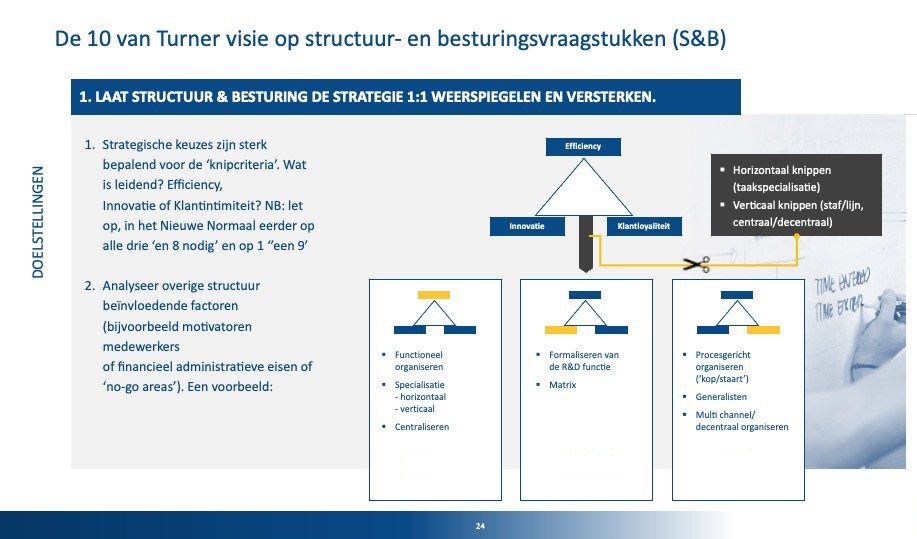
- Let S&B reflect and reinforce the strategy 1:1, see Figure 1. Strategic choices strongly determine the “cutting criteria. Which is leading? Efficiency, innovation or customer intimacy? Note. The new normal requires an ‘8’ on two of them and a ‘9’ on one.
- Ensure That S&G Mirrors and Reinforces Your Strategy
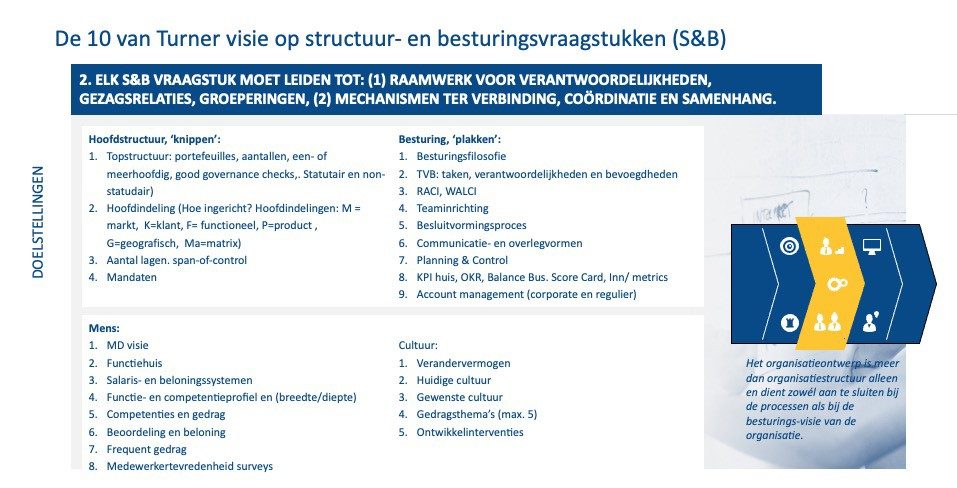
- Main Structure, ‘Cut’:
- Highest level structure: portfolios, numbers, sole or joint management, good governance check.
- Main structure: what is your organization’s main structure based on? Main structures: M = markets, C=customers, F= functionality, P=pro- ducts, G=geographical areas, Ma=matrix.
- Number of layers, span of control
- Mandates
- Governance, ‘paste’:
- Management philosophy
- RRA: Roles, Responsibilities and Authority
- RACI matrix
- Team organization
- Decision-making process
- Communication and consultation
- Planning and control
- KPI structure,
- KPI-system, Balanced Business Scorecard
- Account management (corporate and regular)
- HRM:
- Management Development vision
- Job or position system
- Remuneration systems
- Job descriptions (width/depth)
- Skills and behavior
- Job performance and compensation
- Frequent behavior
- Employee satisfaction surveys
- Corparate Culture:
- Capacity for change
- Current culture
- Desired culture
- Behavioral issues (max. 5)
- Development interventions
- Main Structure, ‘Cut’:
- Outline Your Current S&G
- Qualitative and Quantitative. Note: Start out by creating a comprehensive overview of the current # of FTEs in your company, detailing positions and types of contract.
- Dysfunctional structures show clear symptoms:
- Execution is slow
- Decision-making or implementation is slow or of poor quality
- Organization responds neither innovatively nor quickly to changing environment
- Too many conflicts
- Coordination requires too much effort
- Monodisciplinary changes succeed, but multidisciplinary changes fail
- Large gap between projection and reality
- Gap between operations and support
- Gap between going concern and transformation
- Gap between operations and programs
- Don’t Design New Structures Right Off the Beat. Start from General S&G Design Priciples and Narrow Them Down to Your Own Specific—Hard and Soft—Design
- Focus & Effectiviness
- Simplicity and Clarify
- Affordability: within benchmarks for all metrics: number of levels, spans of control, etc
- Responsibilities as far down the hierarchy as feasible, mandates as comprehensive as feasible
- Agility, Flexibility, Modernness
- Social Responsibility
- Scalability
- Focus on formulas / segments / P&Ls where necessary; shared process where possible
- Working Matrix
- Additional S&G design requirements depending on particular industry / issue / life cycle stage
- Additional design requirements for structure and governance specific to the sector, type of challenge, and/or stage of organizational development.
- CUT: Take the Classic Orginizational Structures and Select te Ones That Apply to Your Organisation
- First ‘cut’ (the main structure), then ‘paste’ (governance). The main structure should cover 80% of all interdependencies.
- Elaborate down to at least the second level below the highest level structure.
- Always take into account the following classic organizational structures
- F = Functionality: the whole of human knowledge and skills with regard to specific activities
- D/P/SBU = Divisions/Products/Strategic Business Units: structure based on your organization’s output
- Ma = Matrix/Hybrid/Multifocus: the solution when D-F-G-hybrid structures don’t work well
- H = Horizontal: employees are grouped around core activities
- Other: G = Geographical and M= Market
- Analyze homogeneity/heterogeneity and variability in order to be able to make choices in your main structure. Apply logical design rules:
- One or more products relatively homogenous => internal differentation
- Several products relatively heterogeneous => internal specialization
- Relatively homogenous, stable, sustainable => relative consolidation
- Relatively heterogeneous, variable, temporary => relative decentralization
- Distinguish Between Organizational Structure and Senior Management Structure.
- Distinguish Between Organizational Structure and Senior Management Structure.
- Organizational structure delineates formal levels and relationships of authority, including the number of levels in the hierarchy and the managers’ and supervisors’ span of control.
- Organizational structure determines how individuals are grouped into divisions and divisions into the organization as a whole.
- Organizational structure includes the design of systems for effective communication, coordination and integration of divisions.
- Design the senior management structure. Make sure the key roles and portfolios are reflected at the board level: profession, sales, financial control, innovation, operations / executive management, strategy execution, etc.Note: apart from the key roles, you also need to include overall positi- oning and thought leadership, identity control, strategy development, execution portfolio, and so on.
- Distinguish Between Organizational Structure and Senior Management Structure.
- A. PASTE: Get Better at Dealing with Constant Change Through Agile Strategy Execution. Become Intrinsically Flexible and Work Smarter Rather Than Harder
- The organization should be designed to expedite the vertical and horizontal flows of information in order to achieve overarching goals. Effective governance ensures more control over the achievement of goals.
- Determine which type of coordination (= management) is appropriate:
- Mutual adjustment
- Direct supervision (foreman)
- Standardization of business processes
- Standardization of output
- Standardization of knowledge and skills (and norms and values)
- Determine which horizontal coordination structures you need:
- Information systems
- Direct contact
- Ways of Working
- Task forces
- Shortcuts
- Integration manager / liaison
- Determine which vertical coordination structures you need:
- Hierarchic referral
- Planning and control
- Ways of Working
- Information systems
- Fleshing out the basics:
- Main structure, span of control, mandates, team organization, management philosophy, RRA, RACI, WALCI, decision-making process, communication and consultation, planning and control, Balanced Business Scorecard, Account Management (corporate and regular), and so on.
- B. PASTE: Design Governance by Defining Horizontal and Vertical Coordination Structures.
- Strategy: Clear vision, flexibility along the way. Short-term and long-term strategy are equally Iterative: developing, emergent rather than a blueprint. Time and resources spent: max 20%.
- Business Model and Propositions: Single focus: customer value creation. Scope: entire value chain and network.
- Structure: Structured, but not Flexibility created by multidisci- plinary teams and collaboration.
- Innovation Vision: Dualism: different speed for innovation, enabled by separate structure and IT.
- Processes: Harmonized wherever possible, flexible where necessay. Chain-level processes rather than department-level processes
- Structure and Management: Small Autonomy and freedom (‘carte blanche’). Rapid response to opportunities and threats, effective risk management and rapid iteration and adjustment based on success/failure. Decision making based on systematic data collection, analysis, interpretation and inference.
- Leadership: Letting go of the impulse to find the one and only solution and showing an ability to unify.
- Culture and Workforce: Intrinsically motivated ownership, want to rather than have to. Self-management. Cross-disciplinarity is second nature
- Execution Vision and Methods: Strategy equals Strategy is based on evidence obtained from execution. Design an MVP, rapidly start executing, learn from failure, adjust, scale up what works.
- Alignment: Across all configurations, every day
- Flexibility and Perseverance: The wisdom to know when to persevere and when to adjust strategy.
- Focus and Simplicity: The less ballast, the easier it is to pivot.
- Safeguard the Operation of Your Matrix. In any organization and in any type of structure, there is a matrix that has to be made operational. Hierarchical versus functional versus project-based versus matrices.
- A. PASTE: Get Better at Dealing with Constant Change Through Agile Strategy Execution. Become Intrinsically Flexible and Work Smarter Rather Than Harder

- Align and Iterate the Other Business Model Elements. Other elements include Ways of Working, HRM, etc.
- Human Resources: Management Development vision, job or position system, remuneration systems, job descriptions (width/depth), skills and conduct, job performance and compensation, frequent behavior, employee satisfaction surveys.
- Culture: capacity for change (see SECA.NU, Turner’s change management method), current culture/conduct, desired culture/ conduct, behavioral issues, development interventions, etc.
- For Every S&G Issue, Take Four Practical Steps
- Step 1: Translate strategy into S&G design principles and decisi- on-making criteria.
- Step 2: Design three or at most four appropriate main structures and list their pros and cons. Choose one.
- Step 3: Elaborate the selected structure and flesh it out to a working management structure.
- Step 4: Make a comparative analysis with the current situation, align with interdependent changes (ways of working, job descriptions, IT, etc.) and draw up a realization plan.
Important user guide for 'The 10 principles of Agile structure and governance (S&G)'
1. Focus and smart combinations
Successful strategy execution requires focus and expertise in transformation initiatives. That’s why this specialised edition of ‘The 10 of’ was developed. At the same time, in modern strategy execution, transformation initiatives (projects and programmes) aimed at reducing costs and improving productivity must not come at the expense of profitability, growth, or innovation. This requires both: a specialised approach to specific challenges, such as provided in this set, and smart deployment and integration of initiatives. We therefore encourage you to also explore the other editions of ‘The 10 of’, covering frequently occurring strategy execution challenges.
2. Apply the core elements of the Strategy = Execution method in a tailored way:
(1) brief analysis and design phases (4–6 weeks),
(2) execution and scaling in waves (not pilots, but self-improving waves),
(3) including benefits management and safeguards.
This includes balancing the hard side (content and targets), the soft side (ownership and execution strategy), and a project- or programme-based approach.
About the Turner series ‘The 10 of…’
Turner supports approximately 75 strategy execution assignments each year, delivered by around 80 specialised strategy execution professionals in both the private and (semi-)public sector. In nearly all of these assignments, combinations of objectives such as cost reduction, talent retention and innovation play a key role.
In the series ‘The 10 of…’, you will find compact, practice-oriented working methods based on what truly works in the face of real-world complexity. Each edition brings together insights that have proven their value in strategy execution across a wide range of clients. This results in a learning approach that is directly applicable and scalable to new challenges and organisations: ‘The Series The 10 of’
Read more about the results other clients have achieved with the support of Turner Strategy = Execution.
Schedule an appointment

Strategy = Execution. Improve, Renew and Innovate Faster
How can organizations make strategy execution their number one priority? And improve, renew and innovate faster? This I describe in my book Strategy = Execution. Strategy = execution is based on the research that Turner started years ago into the success factors of strategy execution and innovation. We interviewed 60 directors and professionals and analyzed more than 75 cases, 300 relevant books and articles.

- More about Jacques Pijl (author) and Turner Consultancy.
- The most popular interventions based on Strategy = Execution
- 24 endorsements from organizational leaders
- American management book of the year 2021, no. 1 in the category of strategic management, in the top 100 bestseller, seventh edition, translated into: English, German, Spanish, Russian and Bahasa.
- Selection of the most important management books according to CEOs of innovative organizations (FD New Champions). Included in library of classics (mb.nl).
- Nominated for Management Book of the Year.
- Countless articles and interviews in FD, Emerce, Frankwatching and CFO.
- Numerous Ted Talks and in-company workshops at the top 25-50 organizations, average rating 8.7.
Contact
We would like to get to know you.
Do not hesitate to contact us if you have any questions!
Huize de Boom
Arnhemseweg 107
3832 GK Leusden
Phone: +31 (0)33 – 285 93 00
Email: info@turner.nl
Make an appointment
Would you like more information or a tailor-made quote? Fill in the form for a no-obligation appointment.