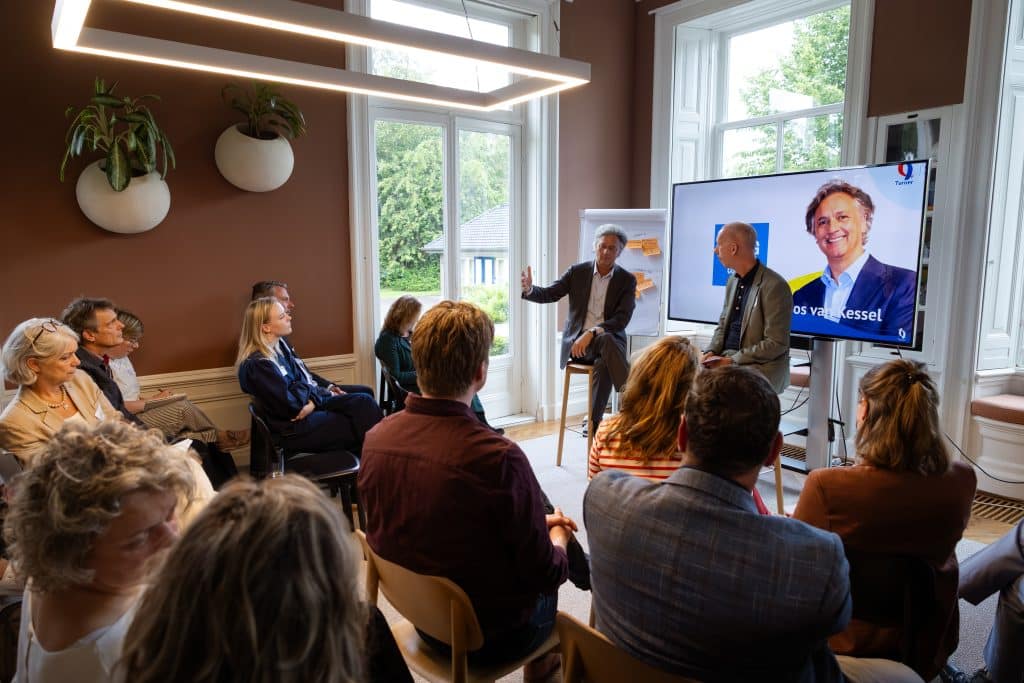
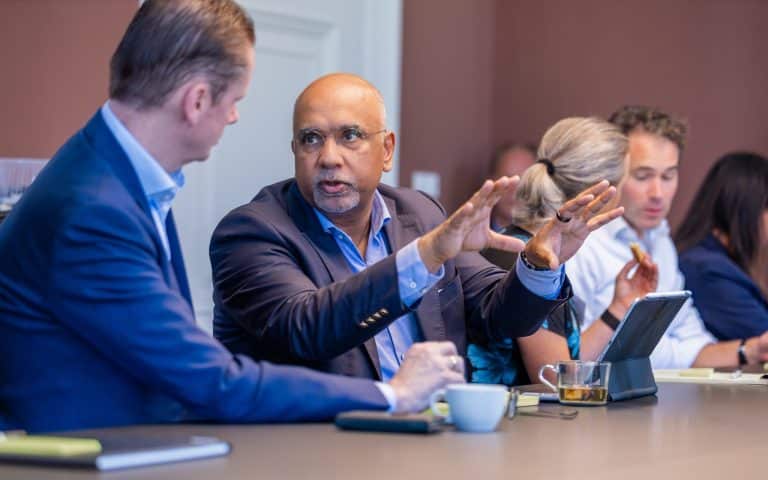
Vinod Subramaniam (University of Twente): “We need to stop thinking small.”
The University of Twente’s mission is to connect technology with society, says Vinod Subramaniam, President of the Executive Board, during Turner’s Masterclass on Strategic Education Portfolio Management. In its education portfolio, the university aims to bring these two domains together—through its faculty of behavioural and social sciences, and by actively seeking collaboration with other institutions. “We’re not competing with each other, but with Shanghai. You have to optimise your local context to contribute to the global agenda,” he states.
Turner provides its clients with timely, relevant, and forward-looking insights into their sectors and the strategy execution challenges they face.
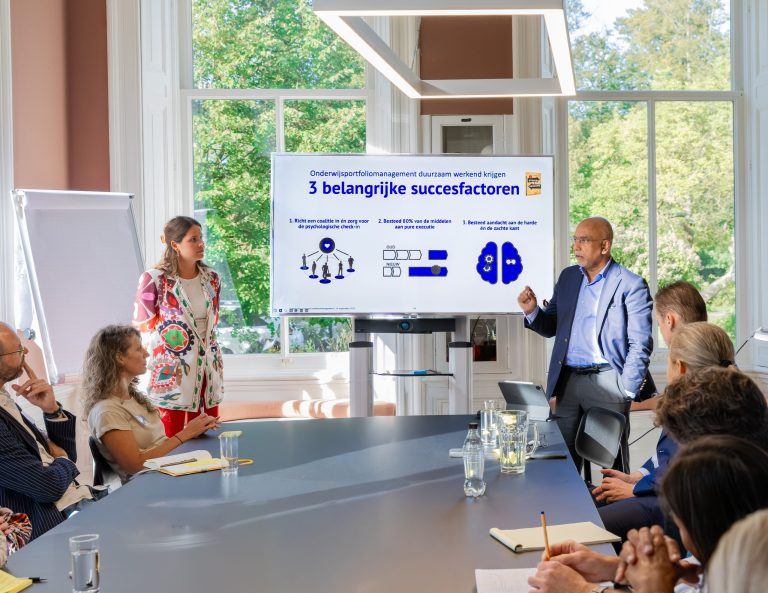
This blog is a report of Turner’s Masterclass on Strategic Education Portfolio Management, exploring the implications of portfolio decision-making for effective strategy execution.
"We’re not competing with each other - we’re competing with Shanghai."
- Universities need to stop thinking small - regional optimisation is essential to pursue a global agenda.
- National and regional collaboration across the entire educational spectrum is crucial: institutions strengthen each other rather than compete.
- Strategic portfolio management requires clear choices in focus and positioning.
- Making choices also means stopping what no longer contributes to the strategy.
- Good governance means less talk, more action – actually following through on decisions.
During his undergraduate studies at Cornell University in Ithaca, NY, Vinod Subramaniam witnessed something that left a lasting impression. Nobel Prize winners considered it an honour to teach first-year students. A telling example, says the President of the Executive Board of the University of Twente. “The core business of universities is education,” he states. “Of course, research is important. But the fundamental purpose of universities is to educate young people. And as a regional university, we also have a responsibility to our region. That is something we tend to lose sight of. The problem we face in the Netherlands is that we simply do not educate enough technically trained people. Only a limited number of Dutch students choose a technical degree programme.”
Like many institutions, the University of Twente is therefore forced to look abroad. But even that can no longer be taken for granted, now that the Dutch government has decided in 2024 that Dutch will become the default language in higher education. “Then I’m inclined to say two things: put your money where your mouth is – and we need English-taught programmes. Companies say: if everything has to be in Dutch, they’ll look elsewhere. We’ll have to go where international talent is both available and welcome.”
The low enrolment in technical programmes is not just a university issue, Subramaniam continues. “It affects all levels of education. In North Holland, only 11 percent of students choose a technical programme; across the Netherlands that figure is just 22 percent. We’ll need to address this collectively. That will require either horizontal integration between universities, or vertical integration – and the latter can only be realised regionally. We already work closely with Saxion University of Applied Sciences and the local vocational college. When three knowledge institutions join forces, you can truly make a difference in the region.”
“We need to broaden our perspective”
Subramaniam immediately sets the tone during the Masterclass on portfolio management for universities when he remarks: “We’re not competing with each other, but with Shanghai.” He later clarifies: “As institutions, we shouldn’t act out of self-interest. We need to broaden our view. The Netherlands has 18 million people, and I grew up in an Indian city with 25 million inhabitants. We need to stop thinking small. We need to optimise the local context in order to serve a global agenda.”
He also puts this into practice at the University of Twente, as he elaborates on how his university seeks collaboration. He expresses genuine concern about the challenges faced by Saxion University of Applied Sciences, which directly impact the University of Twente. “The Civil Engineering programme is struggling at the university of applied sciences, but civil engineering is vital to the region. That’s why Saxion and we are exploring ways to join forces, such as combining the first year of the programme. Other institutions are exploring this too. The advantage for students is that they can decide later whether to continue at a university of applied sciences or a university. We want to move forward together. Our worlds are not separate. In that sense, we aim to be pioneers of the regional agenda.”
“This university has always been a pioneer. Public Administration didn’t exist in the Netherlands until we launched it fifty years ago. Now it’s offered at many universities. Technical Medicine is another example. It’s our way of responding to the needs of today’s generation.”
In Subramaniam’s view, Dutch universities could do much more to respond to societal change. “We’re still offering degree programmes designed twenty, thirty, or even forty years ago, based on the thinking of that time, while today’s students are looking for something completely different. They ask me: where is the climate? Where is sustainability? Where are the energy partnerships? You have to move with the times and consider what society truly needs. Of course, you need a classical foundation – physics and chemistry – but you don’t need to do everything. You have to make deliberate choices. We no longer focus on traditional process technology – others do that. We’ve chosen different focus areas: membranes, sustainable process technology, mesoscale systems. This is a strategic decision to set ourselves apart.”
That naturally goes hand in hand with fundamental scientific research. “Research and education are intrinsically linked,” says Subramaniam. While research is not solely regionally focused, it is always in service of a larger purpose. “We conduct a lot of fundamental research, but it’s driven by real-world problems. We have outstanding researchers inspired by the challenges at ASML and other companies. These are our Spinoza and Stevin Prize winners. Take Detlef Lohse, a theoretical physicist working in fluid dynamics. He’s won every prize you can win – except the Nobel. He’s worked with Océ on inkjet printing, with ASML on tin droplets, with Philips, and many others. You can’t say he doesn’t do fundamental research, but his work is sparked by the questions these companies face.”

‘A Lack of Ownership’
Making choices also means having the courage to stop certain things, Subramaniam acknowledges. Last year, the University of Twente announced the closure of its University College, also known as Atlas. As of this year, no new students will be admitted to the small-scale honours programme. Current students will be able to complete their studies, after which the programme will be fully phased out by 2029. The main reason behind the decision is financial viability: the programme is relatively expensive, and enrolment numbers are low.
“The programme was launched in 2013 but ran into serious difficulties during the Covid-19 period,” Subramaniam explains. “In thirteen years, only 413 students enrolled. That’s clearly subcritical. It’s a beautiful and ambitious programme, but at a certain point you have to conclude: this is no longer feasible. One of the underlying issues was a lack of ownership. That’s typical of interfaculty or interdepartmental programmes. It’s incredibly difficult to assign clear ownership. In good times, that’s not a problem, but when push comes to shove, it becomes very challenging. Full credit to my colleague Tom Veldkamp, the university’s Rector, who held numerous conversations with everyone involved – students, lecturers, and programme staff.”
“Making choices also means having the courage to stop.”
According to Subramaniam, this ability to draw a line is also part of the entrepreneurial mindset that characterises the University of Twente. “At one point, we tried to establish a medical faculty. That didn’t happen – it went to Maastricht. But then we had the opportunity to launch Technical Medicine. And we really made a success of it. That reflects our entrepreneurial drive. We’ve helped launch around 1,300 spin-outs and start-ups, if I’m not mistaken. Major innovations such as WiFi and the Nauta circuit – now found in billions of phones worldwide – were developed here. And alumni have gone on to found major companies like Just Eat Takeaway and Booking.com.”
In the end, sound portfolio management in higher education comes down to execution, Subramaniam adds. “We talk a lot about interfaculty collaboration and so on – but now it’s time to actually do it. That’s also what younger people expect: they want to push boundaries and explore new horizons. I understand it’s hard for universities. We were raised in a disciplinary context, and it’s difficult to move beyond those silos. But the conversation can no longer be avoided. The central question remains: is our portfolio fit for purpose? It may be tempting to sidestep that question, but doing so risks long-term decline. I’ve told a few colleagues before: if you don’t have that conversation, we’ll see you next to the dinosaur bones.”

Targeted Insights for a Robust Education Portfolio
Profolio is Turner’s analytics tool for education portfolio management. It provides vocational colleges, universities of applied sciences, and research universities with an integrated view of the performance and relevance of their academic programmes. Drawing on public data from 25 sources, Profolio delivers a single, comprehensive overview of the economic and quality performance of programmes, as well as their relevance to prospective students and the labour market.
Tailored to your institution, the tool enables meaningful benchmarking with peer institutions. The underlying framework is grounded in Turner’s extensive experience with education portfolio management and strategy.
A Model for Portfolio Management
Based on in-depth analysis and best practices at higher education institutions, Turner has developed a universal model for strategic portfolio management. The model consists of four core components:
Strategic portfolio management is a cyclical process that requires a structured approach with clear steps, timelines, and leadership.
A decision-making framework provides guidance in prioritising developments aligned with institutional strategy. It ensures an integrated perspective and objective assessment across multiple dimensions.
Analysis and insights form the basis for determining how individual programmes align with the decision-making framework. A pragmatic analytical lens ensures focus and is complemented with relevant contextual information.
A results-oriented dialogue creates space for both institutional and programme-level interests to be addressed in a constructive way.
Would you like to improve, innovate, and transform faster?
Turner is specialized in strategy execution. We make it our business to turn an organisations strategy into reality. For the seventh consecutive year, Turner has been recognized by clients as the best strategic consulting firm in the Netherlands. More than 4,000 executives and professionals participated in the MT1000 survey, in which Turner received the highest ratings for strategic consulting, client focus, excellent execution, and product leadership.

Read more about the results other clients achieved with the support of Turner Strategy = Execution. Ready to talk? Schedule an appointment. Contact us.
Want to learn more about Turner Education?
How do universities, universities of applied sciences and vocational institutions contribute to the talent and knowledge development our society demands—today and in the future?
All sectors of education face the same strategic challenge: designing programmes that remain relevant, affordable and deliverable.
Turner Education supports education professionals in making clear strategic choices and executing them effectively.
Together, we elevate education—with a clear strategy, well-supported decision-making and tangible results.
Make an appointment
All insights on education from our specialists

Educational Portfolio Management: Don’t Get Stuck in Dilemmas—Make Clear Choices
Educational institutions can no longer afford to operate in isolation. “Through mergers and collaborations, we are able to retain talent for the region and continue to invest in high-quality Education,”

Sustainable Improvement in Academic Success
High dropout rates and low completion rates. Utrecht University of Applied Sciences therefore sought to improve academic success in a comprehensive and systematic manner.

What Educational Institutions Need to Do Now to Continue Innovating After the COVID-19 Crisis
It’s all hands on deck in education: all schools are closed, teachers are sick, and yet classes must go on. A lot is being asked of teachers, support staff, and

Consultancy.nl | Four Strategies for Innovation in Education
In response to our study on innovation at universities of applied sciences, Consultancy.nl has published an article on innovation strategies for educational institutions. The four strategies for innovation in education

Seven Tips for Accelerating Innovation
Educational Innovation Seven Tips for Accelerating Innovation Turner conducted research on the effectiveness of universities of applied sciences when it comes to educational innovation. In

Consultancy.nl | Jeroen Visscher Leads the Education Working Group of the AI Coalition
AI Jeroen Visscher leads the AI Coalition’s Education Working Group Consultancy.nl has also published an article about the contribution that Turner’s managing partner, Jeroen Visscher,
Colleges: Where Is the Real Innovation?
Education Colleges: Where Is the Real Innovation? Turner conducted a study on educational innovation among 25 deans and administrators at 14 colleges. Colleges: Where Is

NHL and Stenden
Collaboration Model and Transition Path for a Merger NHL and Stenden Shared Ambitions and Opportunities Coordination of the Entire Program Higher-quality education and research NHL
More assignments

Sustainable Improvement in Academic Success
High dropout rates and low completion rates. Utrecht University of Applied Sciences therefore sought to improve academic success in a comprehensive and systematic manner.

NHL and Stenden
Collaboration Model and Transition Path for a Merger NHL and Stenden Shared Ambitions and Opportunities Coordination of the Entire Program Higher-quality education and research NHL

HAS University of Applied Sciences
Accelerated Implementation of the Educational Vision Flexible and Adaptive Education Made a Reality A Concrete Vision for Educational Reform Insights into the Progress of Educational Reform Self-Assessment for Faculty and

Noorderpoort
Digital Innovation in the Classroom ROC Noorderpoort Experimentation in Education Innovation in Attendance Tracking Saving Class Time Digital Innovation is high on the agendas of

The Hague University of Applied Sciences
Faster assistance for students Clear responsibilities for teaching and education support staff A practical improvement plan for a critical process: testing and examinations. Accelerating progress on challenging issues: fraud detection

College of Woodworking and Furniture Design
Improved ordering process for students and faculty Smarter procurement of materials More even workload for “stores” (fewer peak periods) More efficient administration and better control over finances Foundation for continuous

Noorderpoort
A new direction for Noorderpoort that aligns with society in 2035. Strategy Execution: immediately testing the strategy in practice through experiments. Close alignment with the needs of students and the

Radboud Academy
The successful application for the LLO Catalyst from the National Growth Fund stems from the partnership between Radboud University, Maastricht University, and the Open University to collaborate on Lifelong Development.

From Delay to Control: HR, Finance, and Procurement Process Teams in Action at a University
From Delays to Control: HR, Finance, and Procurement Process Teams Up and Running A university Direct impact on organizational results The new ERP system went

Landstede MBO
“Lifelong Development is now firmly established.” Landstede(tag) has fully integrated Lifelong Development (LLO) into its vocational education (MBO) programs. With a clearer vision, collective ownership, and a strong Execution Coalition,

ROCvA-F
How do you drive progress in digitalisation within a decentralised education organisation? At ROCvA-F, a smart approach involving a ‘0.7 version’ led to greater clarity, support and acceleration.
INNOVO
The development of INNOVO’s new course plan in South and Central Limburg was an unconventional exercise. Due to previous circumstances, the 43 affiliated schools had only recently developed their own
Contact
We would like to get to know you.
Do not hesitate to contact us if you have any questions!
Huize de Boom
Arnhemseweg 107
3832 GK Leusden
Phone: +31 (0)33 – 285 93 00
Email: info@turner.nl
Make an appointment
Would you like more information or a tailor-made quote? Fill in the form for a no-obligation appointment.