Strategy execution is a business process like any other.

Nothing as practical as a good model.

Especially for strategy execution.

No manna from heaven

Everyone is trained to think in business processes: sales, logistics, delivery, service, administration, management and human resource processes. But when it comes to strategy execution, this thinking suddenly seems not to apply, as if strategy execution can be taken for granted and will fall from the sky like manna from heaven. Yet strategy execution is just another business process, which needs to be described and implemented like any other. My publication Strategy = Execution contains a model that is a great basis for this.

Single Language

We execute strategy in an ever more complex and volatile world. Using a single method and a single language for strategy execution creates the time and flexibility to deal with our rapidly changing world. Taking a systematic approach and making sure you know which phase an initiative is in helps to successfully complete that phase and the whole initiative. This is true not only during analysis, but also during execution.

At one point, I helped a senior manager at a large insurance company to create a single method and language for strategy execution. Speaking about the use of a phased or step-by-step model, he said: “At any given moment, each initiative will be in a different phase from all the others. But every one of them has to go through every phase. In the heat of the moment, we often don’t know what phase a particular initiative is in. And when it gets stuck or fails to deliver, we’re surprised. But that’s because we keep stepping into the classic pitfall of only approaching our initiatives systematically while we’re defining them. When we most need to be systematic, during execution, our minds tend to be elsewhere.”

Framework Wanted

At the end of the day, every leader I’ve ever met wants a practical framework. And they’ve got a point, because everyone benefits from a good model. It helps everyone speak the same language, helps them read from the same page. And a process model or framework also provides a peg from which to hang best practices, so we can convert generic steps into concrete actions.

Thinking in accelerators, stages, phases or steps—whatever you prefer to call them—helps you realize what needs to be done.

The Strategy = Execution Model: 4 Accelerators and 16 Building Blocks

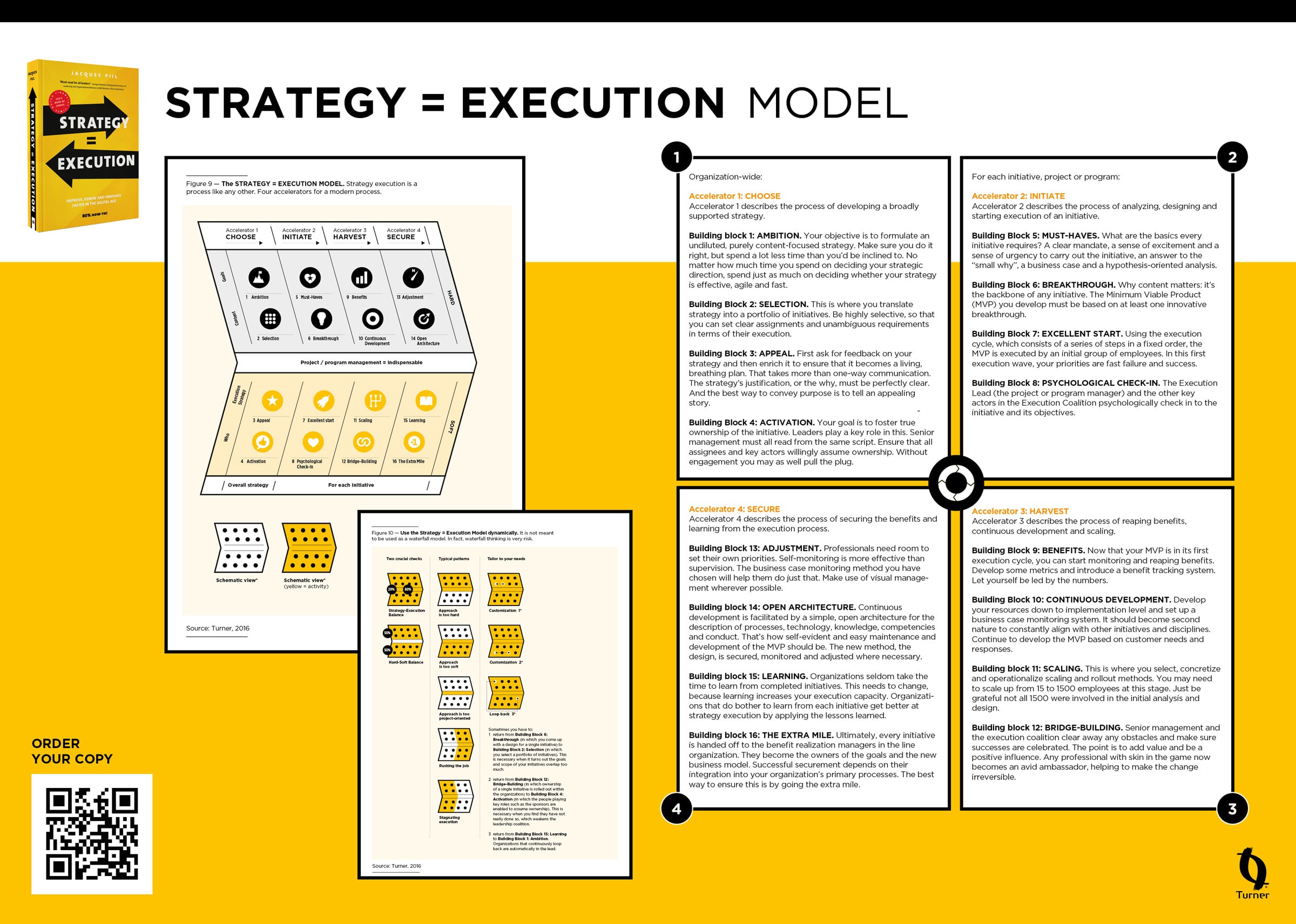
From my research results, I was able to distill four accelerators of strategy execution. Together, these key elements form a framework that shows you how to execute your strategy. This is the Strategy = Execution Model.

The first accelerator—CHOOSE—applies to the organization-wide process of setting the overall strategy while the other three—INITIATE, HARVEST and SECURE—are intended for executing strategic initiatives such as programs and projects. Each accelerator consists of four how-to building blocks, two of which deal with your organization’s hard capabilities, and two with its soft capabilities.

The top row of hard building blocks deals with goals and benefits, or the why. The next row of hard building blocks refers to the contents of the strategy and the portfolio of initiatives, or the what. The top row of soft building blocks is about the execution and change strategies, or the how. The second row of soft building blocks is about ownership of the initiative and the desired benefits, or the who. Altogether, the accelerators and building blocks are the how-to for the future. In that sense, they are “future practices” rather than best practices.

Working in projects and programs is a must. It is an indispensable skill and a core competency for most strategy execution initiatives. See the figure below for the Strategy Execution Model.

Logical Coherence

For any process to be effective, it needs to be comprised of logical steps with an overall coherence. The idea is to eliminate any redundant steps. In real life, however, things are often tricky and you seldom start a project with a blank slate. There is no building from scratch. Therefore, I would advise you not to use the framework in a step-by-step, waterfall manner, but to work from right to left and from the bottom up. Every building block can be used independently. To use it sensibly, you will by definition need to take into account what industry you’re in, what type of organization you work in, what issue you’re addressing, and your organization’s ambitions, capacities and maturity. A good chef relies on culinary principles, not standard recipes.

Our research has shown that all successfully executed strategies feature the four phases (accelerators) and 16 building blocks. Their indispensability means that you can’t just pick and choose any at will. Within the context of each building block, there is obviously room to tailor it to the specific needs of the project. And in some cases, you can skip a building block or two. For example, a small project aimed at introducing a regulatory change does not require appealing storytelling.

Dynamic Use

I recommend using the Strategy Execution Model dynamically. Yet it is smart to keep an eye out for a few specific balances. First of all, you need to make sure that your hard and soft capabilities are in balance. You also need to verify that you’re spending 20% of your time and resources on strategy and 80% on execution. In addition, you need to look out for some typical patterns—or rather unbalances—we frequently found in organizations’ change portfolios. And last but not least, it’s important to check whether using one building block independently automatically necessitates the use of another one.

Three thoughts on the distinction between strategy and execution

Strategy Equals Execution

If strategy is defined as deciding why you want to achieve a particular goal, how you go about it, and with whom, then the act of devising a strategy with co-designers already influences and initializes a process. And if execution is defined as carrying out that which has been devised, this does not mean execution has to be a passive, mindless job. In fact, you expect the professionals in your organization to keep adapting the strategic plans as often as necessary, depending on what does and doesn’t work, especially in the digital age.

You Can’t Have Strategy Without Execution, But You Should Be Able To Tell Them Apart

In the course of our research, the more philosophically inclined leaders we interviewed raised the question whether there was any difference between strategy and execution; weren’t they the same thing? In the 1990s, Professor of Management Studies Henry Mintzberg pointed out the importance of the strategy-execution interaction. That’s a key dichotomy to keep in mind, especially in the New Normal. Strategy and execution have an impact on each other and iterations between the two must be possible. Yet it is necessary to distinguish between them. Otherwise, you get the same problem as with responsibility: if everyone is responsible, no one takes responsibility. There are essential steps in strategic planning and strategy execution that can’t be lumped together. Each requires a special focus and approach. If you don’t pay heed to this difference, you will get neither your strategy nor your execution right.

Less Important Distinctions

No one should really give a toss whether this is an open or closed, planned or evolving, green or purple change vision. Who cares whether it’s a fixed destination or an adventurous backpacking model? Change management experts are too keen to pigeonhole every approach. This generates a lot of unnecessary polarization. The Strategy = Execution Model describes universal elements, or building blocks. Each building block has proven its worth in strategy execution. So you can’t just pick and choose at will. At the same time, the model allows for tailor-made adaptation and situational use. That’s why I advocate the dynamic use of the model. Nonetheless, an open or “journey-based” approach to change management can be a great way to kick off the process and can even lead to a measurable and tangible strategy execution result. Such an open approach will gradually become more closed as the process evolves and moves towards an increasingly clear goal and set of solutions.


Strategy = Execution. Improve, Renew and Innovate Faster

How can organizations make strategy execution their number one priority? And improve, renew and innovate faster? This I describe in my book Strategy = Execution. Strategy = execution is based on the research that Turner started years ago into the success factors of strategy execution and innovation. We interviewed 60 directors and professionals and analyzed more than 75 cases, 300 relevant books and articles.

  • More about Jacques Pijl (author) and Turner Consultancy.
  • The most popular interventions based on Strategy = Execution
  • 24 endorsements from organizational leaders
  • American management book of the year 2021, no. 1 in the category of strategic management, in the top 100 bestseller, seventh edition, translated into: English, German, Spanish, Russian and Bahasa.
  • Selection of the most important management books according to CEOs of innovative organizations (FD New Champions). Included in library of classics (mb.nl).
  • Nominated for Management Book of the Year.
  • Countless articles and interviews in FD, Emerce, Frankwatching and CFO.
  • Numerous Ted Talks and in-company workshops at the top 25-50 organizations, average rating 8.7.

Make an appointment

Would you like more information or a tailor-made quote? Fill in the form for a no-obligation appointment.

Would you like to improve, innovate, and transform faster?

Turner is specialized in strategy execution. We make it our business to turn an organisations strategy into reality. For the seventh consecutive year, Turner has been recognized by clients as the best strategic consulting firm in the Netherlands. More than 4,000 executives and professionals participated in the MT1000 survey, in which Turner received the highest ratings for strategic consulting, client focus, excellent execution, and product leadership.

MT1000 EN Series

Read more about the results other clients achieved with the support of Turner Strategy = Execution. Ready to talk? Schedule an appointment. Contact us.

A selection of our assignments

Curious about more results from our clients? View the full selection here.

Klimmendaal

At the initiative of Verstegen Accountants in Dordrecht, Edwin Schippers of Turner conducted an organizational assessment of Klimmendaal, a rehabilitation center headquartered in Arnhem. The organization was facing several challenges:

Read More »

A selection of our insights

Curious about more of our insights? View the full selection here.

Podcast Make Sense of AI

Welcome to ‘Making Sense of AI’, where we unravel the complexities of artificial intelligence and explore its profound impact on our world. Each episode we dive into the excitement and

Read More »

5 Data Governance Tips

Artificial Intelligence 5 Data Governance Tips: Don’t Let Your “Data Lake” Turn Into a “Data Swamp” Frits Korthals Altes of Turner sees many organizations starting
Read More »